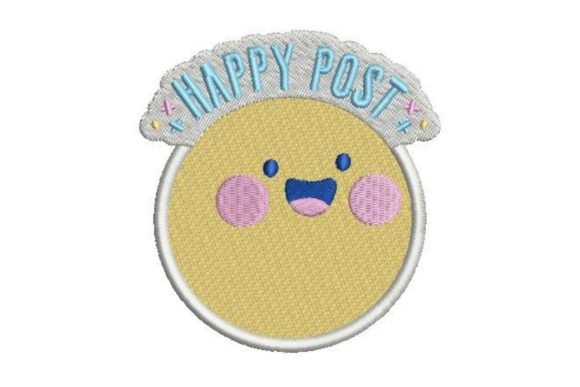
Smiley Face Happy Post: A Designer's Review for Craft Fairs
As an experienced embroidery designer who has spent countless weekends prepping booths for local craft fairs and online handmade markets, I know that the difference between a stall that sells out and one that gathers dust often comes down to one specific factor: the design. Today, I am reviewing a specific digital asset called Smiley Face Happy Post. This is not just about stitching a simple icon; it is about evaluating whether this piece of art will translate into a high-value product that customers actually want to buy. When you are standing behind a table filled with tote bags, aprons, and tea towels, your design needs to do more than just fill space. It needs to bring joy.
The First Impression: Bold Joy Meets Market Appeal
When I first looked at the description for Smiley Face Happy Post, calling it a "cheerful sticker" that brings joy to any fabric, my mind immediately went to the visual impact on a display table. In the world of machine embroidery design, simplicity is often the key to mass appeal. The title suggests a vibe that is modern, friendly, and accessible. Unlike intricate floral patterns that might feel too formal or rustic farmhouse designs that can be polarizing, a smiley face design hits a universal note of positivity.
This design feels perfect for the "Inspirational" category because it delivers a quick emotional hit. For a craft fair seller, this is gold. Customers are scanning rows of items quickly; they need something that catches the eye from three feet away. Smiley Face Happy Post works as a focal point that says "happy" without needing words. It fits seamlessly into trends that favor soft, minimal, yet decorative accents. Whether you are targeting Etsy sellers looking for small shop product ideas or boutique makers wanting to add a touch of whimsy, this design has the potential to stand out in a sea of complex florals.
Product Versatility: Where Does It Shine?
One of the most critical questions I ask myself before turning a digital file into inventory is: "Where does this look best?" The description mentions that this is an easy project suitable for spending time with kids, which hints at its versatility. Let's break down how Smiley Face Happy Post performs across various high-demand categories.
- Tote Bag Design: This is arguably the best use case. A large, cheerful smiley on a canvas tote bag is a classic market item. It photographs incredibly well for online listings and looks great as a standalone handmade product.
- Apron Embroidery: For kitchen-focused fairs, placing this on a white or denim apron creates a welcoming, homey feel. It transforms a functional item into a giftable piece.
- Tea Towel Embroidery: The contrast of bright thread on linen or cotton makes this design pop. It adds a playful element to a kitchen that many buyers are currently seeking.
- Embroidered Patch: If the design includes a clean border, it can be cut out and used as a detachable patch for jackets or hats, expanding its utility beyond just fixed embroidery.
- Fabric Pouches and Pillow Covers: These smaller items allow for higher profit margins per square inch of production. A set of matching pouches with Smiley Face Happy Post creates a cohesive collection that encourages bulk buying.
For digital sellers creating printable mockups, this design offers endless possibilities. You can visualize it on dark backgrounds, light pastels, or even patterned fabrics to show customers the range of options available.
Production Practicality and Batch Efficiency
From a business owner's perspective, efficiency is everything. Can you produce this in batches? Yes. Because Smiley Face Happy Post is described as an "easy project," it implies a straightforward digitization that should run smoothly on standard machines. This reduces the risk of thread breaks or misalignments, which are the enemies of a smooth production day.
However, we must discuss the stitch density. If the design is too dense, it may become stiff on delicate fabrics like tea towels or thin tote bags. Conversely, if it is too sparse, it might look cheap on thicker materials. The goal is to ensure the design maintains clarity whether it is a small accent on a cap or a large focal design on a pillow cover. For Etsy sellers and commercial embroidery businesses, knowing the hoop size requirements is essential to avoid wasting time re-hooping or resizing during peak sales periods.
Critical Considerations for Success
Before you start churning out finished products, there are several technical aspects to consider to ensure your brand remains consistent and professional.
Fabric Texture and Color Contrast
A smiley face relies heavily on contrast. On a dark fabric, the thread colors must be vibrant enough to cut through the background. On a textured towel, the stitches need to be robust enough to sit above the weave without getting lost. I always advise testing the embroidery file on scrap fabric that matches your final product material. This helps you judge if the design loses clarity when stitched onto rougher textures.
Small Details and Lettering
If the design includes text alongside the smiley, check the legibility. Tiny lettering often fails on curved surfaces like caps or on items that will be washed frequently. Ensure that any text elements are large enough to be read by a customer browsing a busy booth. If the design is intended for children's projects, the lack of tiny, frustrating details is a major plus.
Commercial Licensing and Usage
As a reviewer, I must remind all creative entrepreneurs to confirm the commercial licensing terms before selling finished goods made from this digital embroidery file. Some designs are for personal use only, while others allow for unlimited sales. Understanding these rights protects your business and ensures you are using design assets legally.
Final Verdict: A Strong Contender for Your Booth
In conclusion, Smiley Face Happy Post has the potential to be a standout item in your craft fair lineup. Its cheerful nature aligns perfectly with the current demand for uplifting, positive home goods. By carefully selecting the right fabric, ensuring proper stabilizer usage, and creating high-quality finished product samples, you can leverage this design to drive engagement and sales.
Remember, the success of your booth depends on the quality of your execution. Take the time to create at least one real mockup, compare different thread colors, and inspect the stitch density closely. When done right, a simple smiley face can turn a basic tote bag into a best-selling favorite, proving that sometimes the simplest designs bring the biggest joy.